
Electricity: making life a million times easier
27/10/2010 | WAYFARER | NS
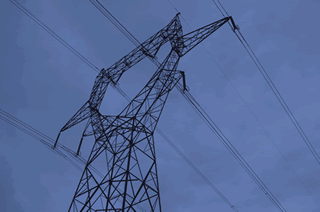
If we were to go back in time to fetch some kids from the 1700s and bring them back here, they would be utterly shocked at how we lead our lives in the 21st century! Virtually all tasks today are "automated" in some or other way, and we all use electricity every single day of our lives.
There is virtually an infinite amount of electrical appliances in existance, and we all use some of them. Electricity runs appliances. Electricity is also a means to transport energy.
Let's discuss this a bit more. When coal burns in a coal power station, chemical energy is converted into heat energy. This heat energy is converted into kinetic energy, which in turn is converted into electrical energy. This electrical energy is transported over long distance through a conducting medium (wires), where eventually electrical appliances convert the electrical energy into various other forms of energy, such as kinetic, light and heat energy.
In hydrolectric systems, the moving water turns turbines, converting kinetic energy into electrical energy, and the rest goes exactly as is mentioned in the above paragraph.
Nevertheless, electricity requires a circuit in which to travel and function.
When charged particles build up in an object it is called static electricity. Another kind of electricity occurs when electrons flow in a current. A battery and wires can make current flow.
The battery pushes electrons from the negative terminal (where there are many electrons), through the switch, the light bulb, and the wire into the positive terminal (where there are not many electrons). As electrons pass through the wire and into the light bulb, a special kind of wire inside the bulb, called a filament, lights the bulb. Have you ever heard a light bulb pop when it burns out? The filament has broken and the flow of electrons has been interrupted.
An excellent resource that explains electrical circuits in a clear and interesting manner can be found at http://www.docstoc.com/docs/25127105/BASIC-ELECTRONIC-CIRCUITS-EXPLAINED . PLEASE DO VISIT THIS SITE AND READ THE WHOLE LESSON BEFORE COMMENTING.